BeHere / 1942 is a multi-faceted project. Each section below introduces components of the project as they have appeared in various exhibitions.
The BeHere / 1942 project originated in 2022 as an exhibition at the Japanese American National Museum (JANM). Titled BeHere/1942: A New Lens on the Japanese American Incarceration, it opened exactly 80 years after the Saturday in May 1942 when Little Tokyo’s streets were emptied. Both in the exhibition space inside the museum, and in an open-air work located outside, I mobilized a variety of media forms to let visitors engage in new ways with this dark historical moment.
The centerpiece of the exhibition was a groundbreaking public art installation located in the plaza between the Japanese American National Museum’s main campus and the historic Nishi Hongwanji Buddhist Temple. The site-specific installation, still accessible today by means of the BeHere / 1942 app, used augmented reality technology–commonly referred to as AR—to invite visitors into the past, letting them walk among Japanese Americans as they prepare to depart for the camps, in one of the places where they really did gather to board the buses that would take them there.
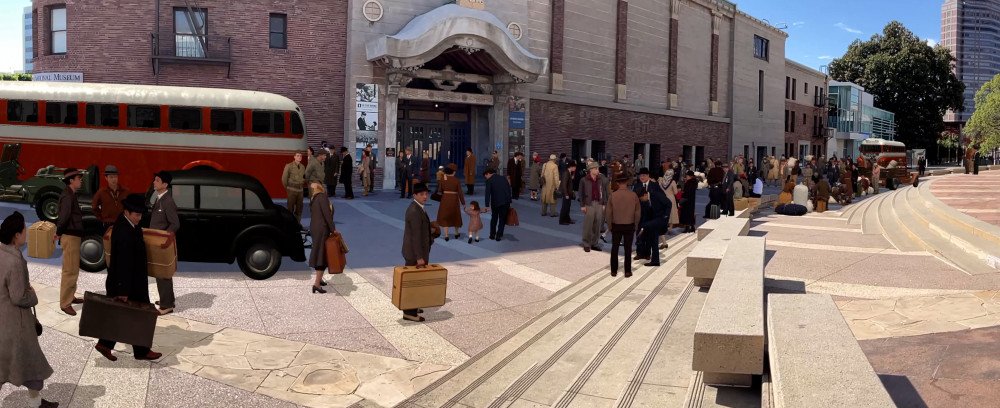
When I was creating the installation for the JANM exhibition in Los Angeles, I tried to be as thorough as I could in researching photographs of the forced removal, but of course ultimately I couldn’t learn enough from them to reproduce the event exactly as it was. I had to rely heavily on my imagination, and also draw on photographs that hadn’t been taken in Los Angeles at all—in particular, pictures of the forced removal in the San Francisco area. Once I had finished my research, we recruited volunteers from the Los Angeles Japanese American community who roughly matched the age and demeanor of first-generation Japanese Americans from the period, including many whose parents or grandparents had experienced life in the camps, and three who had themselves been incarcerated as children. I then created simple scenarios, and we worked with the volunteers to film them.
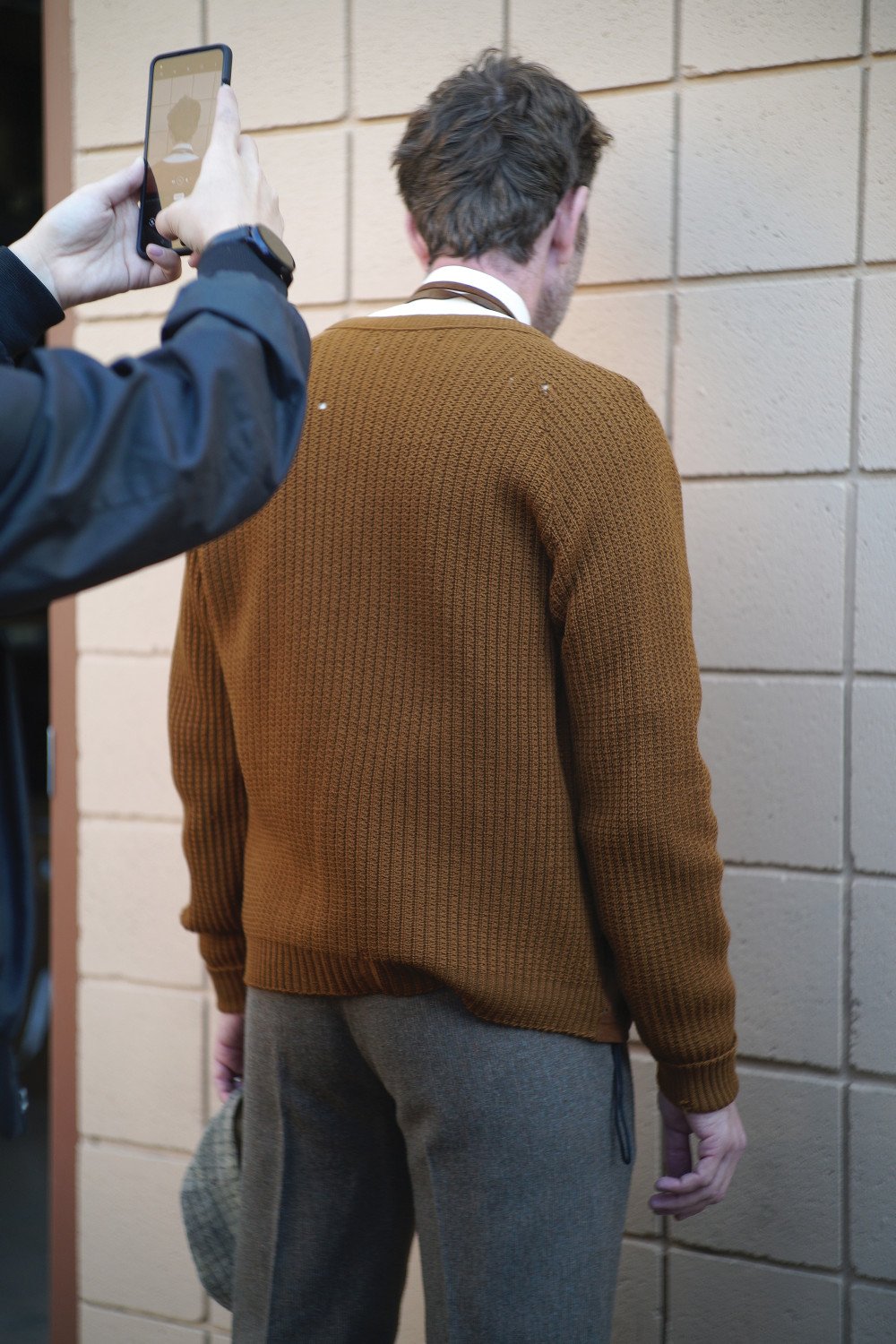
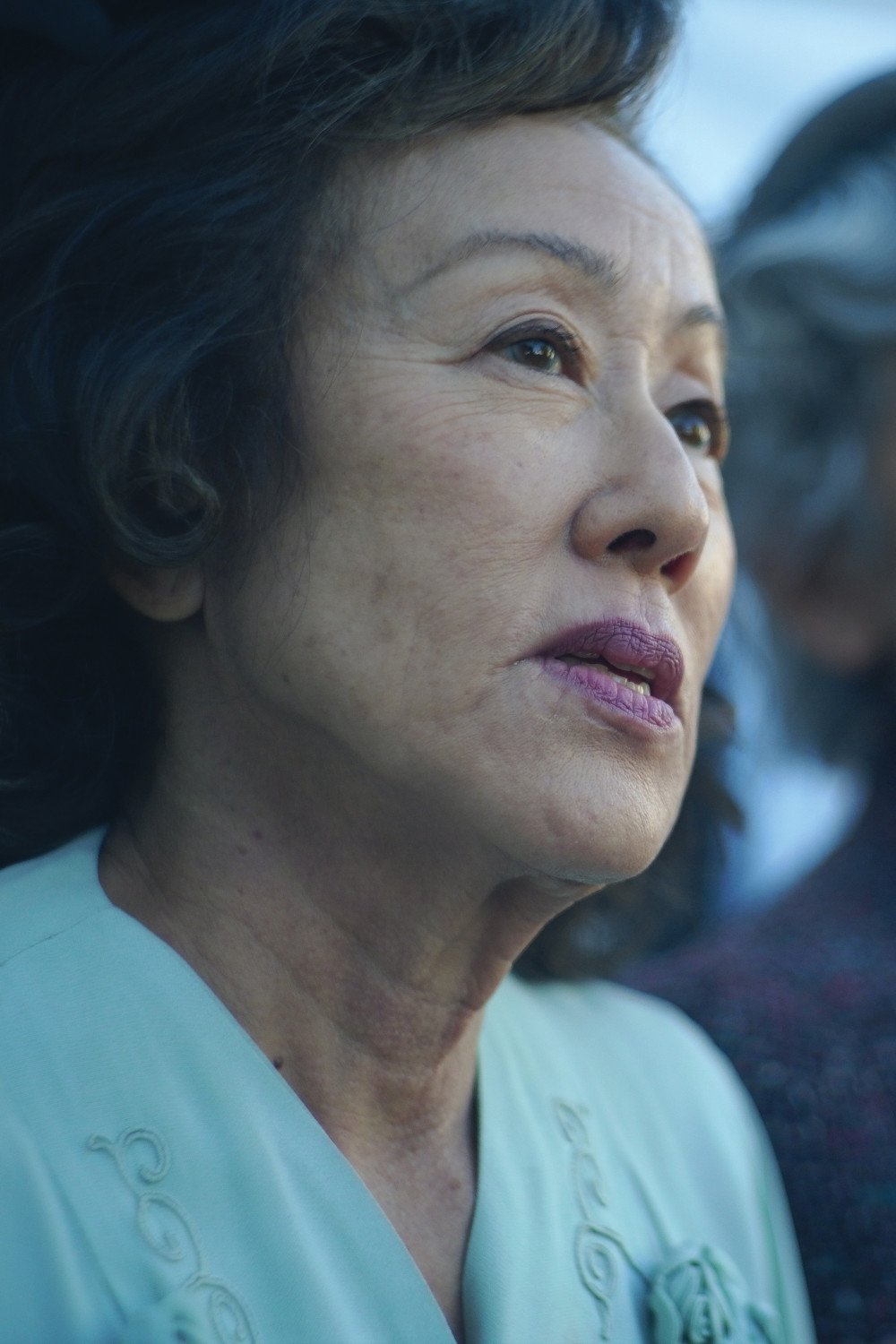
The filming was done using a new technology called volumetric capture in two different studios: Crescent Corporation in Tokyo, and 4DFun in Los Angeles. The process involved filming participants with multiple cameras suspended on a spherical scaffolding in a specialized studio—48 cameras in Tokyo, 32 in Los Angeles—and then combining the data to form a string of sequential 3D models. This was the first time anywhere in the world that volumetric capture technology had been used on such a large scale in a public art installation.
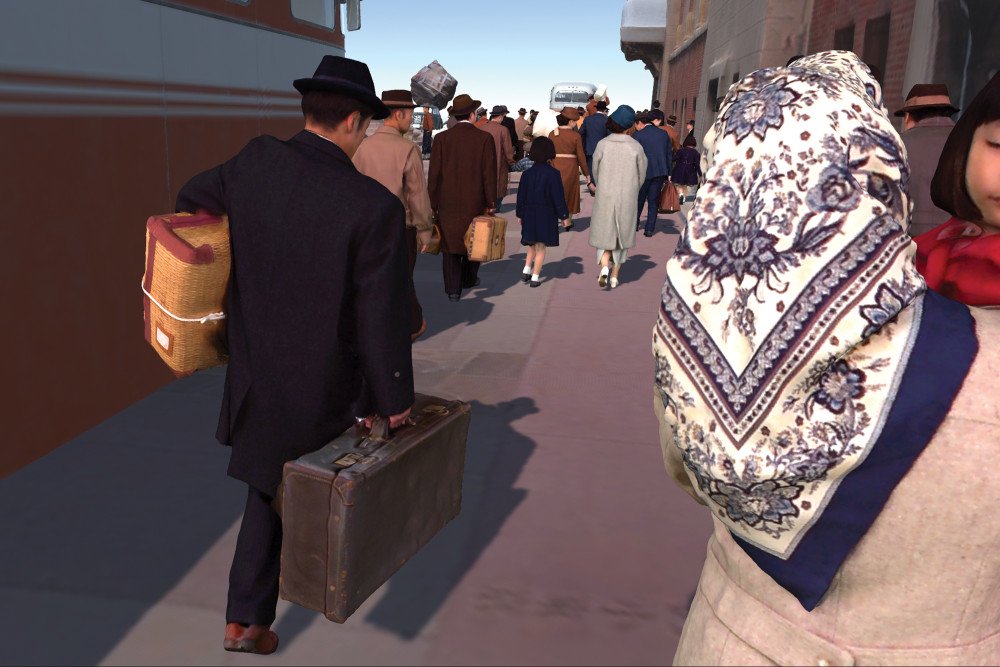
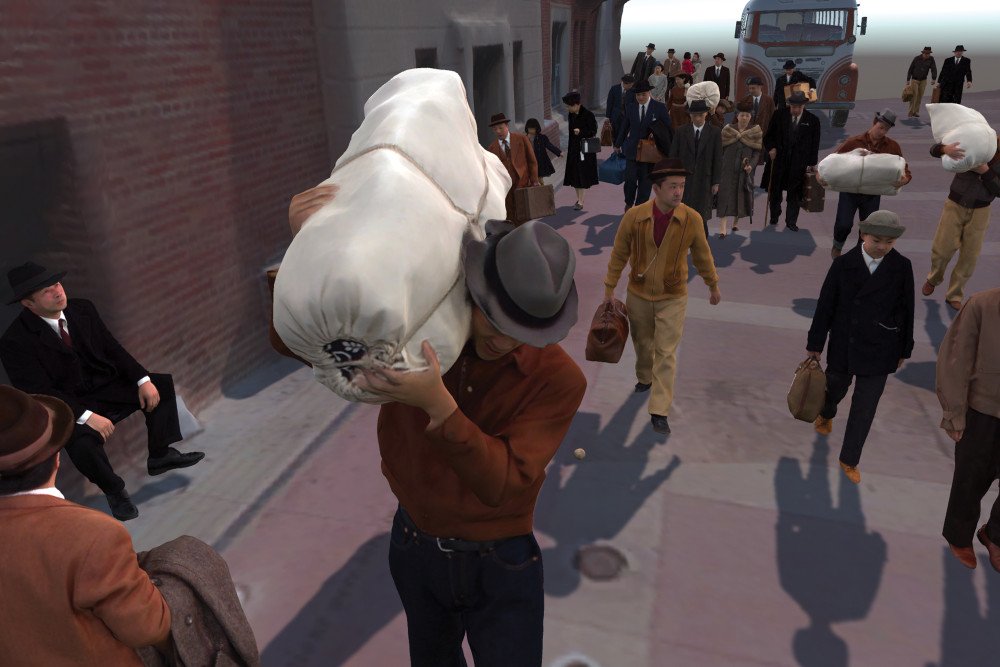
Generally, new visual technologies such as virtual reality (VR) and AR tend to be taken up rapidly by entertainment companies, which try to incorporate the technology into games and movies, and emphasize how ‘fun’ the new experiences they offer are. These games and movies present us with an unreal amount of information, creating a sense of total immersion; there is, however, something frightening about the experience of being embedded in a 360-degree environment, since you can never see what is behind you. You feel as if you are surrounded, like you are being observed by something or someone. It occurs to me that this feeling of total containment must be similar, in certain ways, to what Japanese Americans felt as they waited for the buses to arrive. In part, BeHere / 1942 was an attempt to draw on that element of these new visual technologies, to use them in a way that wasn’t focused on entertainment, but on art, and its power to help us see things differently.
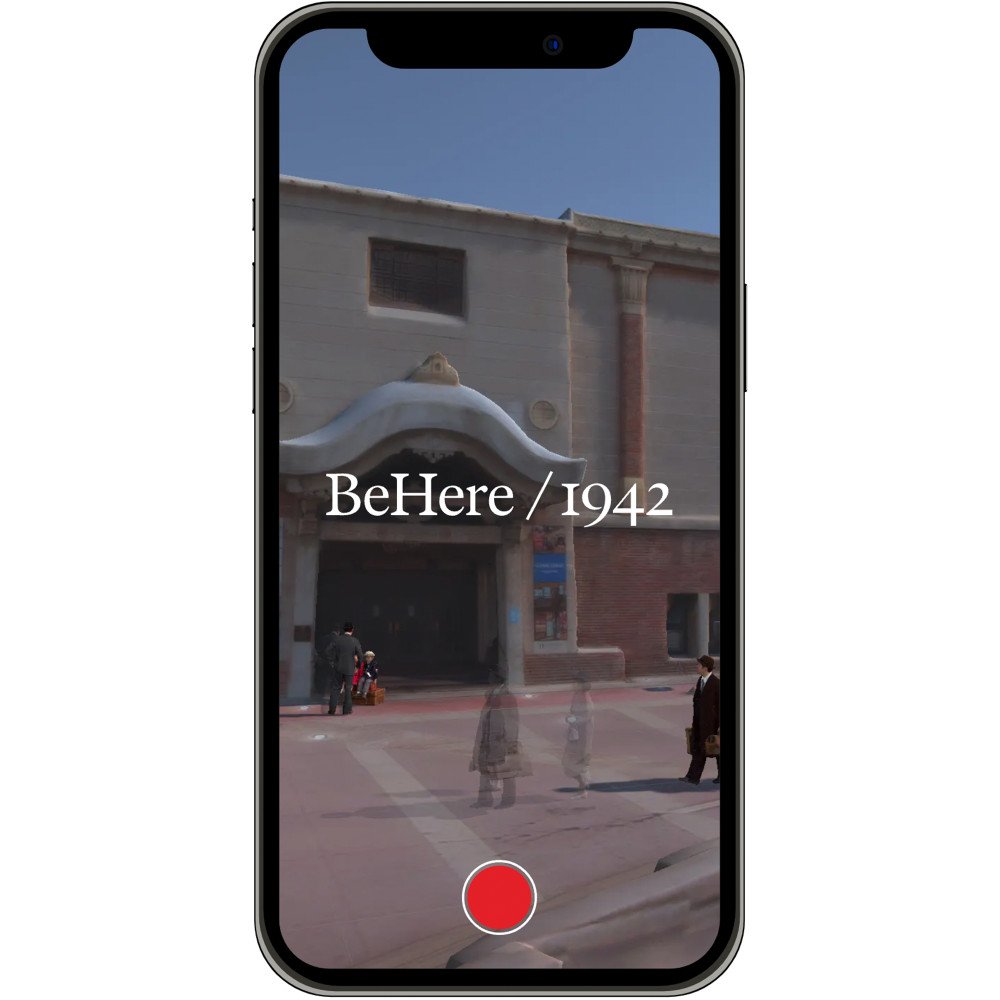
Not only does the 1942 incarceration of Japanese Americans continue to stand as a warning to us about racism and the maintenance of a democratic society; it also, I think, links up directly with other contemporary problems, such as media’s tendency to create hierarchies, and the fundamental, incredibly important issue of how we look at others. And, of course, what it means to take pictures and videos of other people in the darkest moments of history, as part of the experience of bearing witness.
The exhibition at the Japanese American National Museum closed on January 8, 2023. In my mind, though, BeHere / 1942 was too important to end there. Three years later, in 2026, I was fortunate enough to be able to work with the Yanai Initiative and the Oakland Museum of California to realize a new version of the BeHere/1942: A New Lens on the Japanese American Incarceration exhibition, centered on a new site-specific AR installation created especially for Oakland. This installation recreates the scene that unfolded on Oak Street on May 7, 1942, as Oakland’s Japanese Americans were shipped off to the camps.
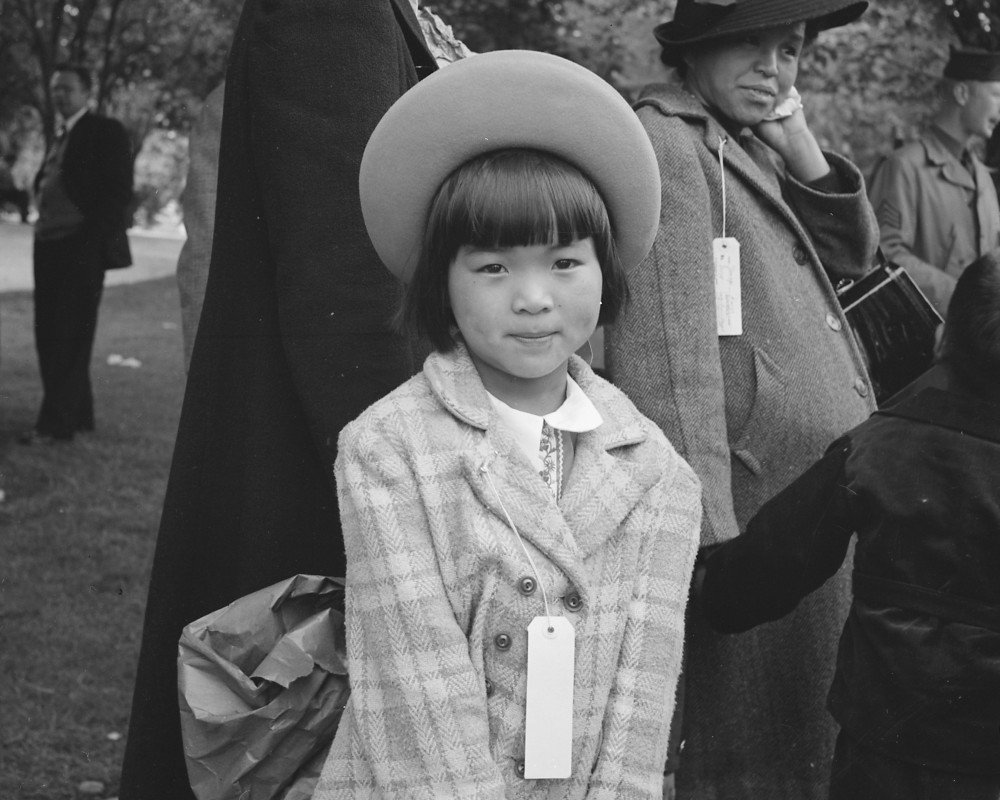
Looking at a photograph is like exploring the ruins of an old building—each gives us a similar sort of pleasure. In the case of ruins, though, the entrance is often obscured, power lines no longer anywhere to be found. Perhaps the floor has rotted out, the ceiling caved in, such that what life once existed there can only be imagined from the rubble that remains. In a photograph, at least, something definitive appears to us—a figure playing with a dog, a family eating a sliced-up apple: proof of real people who once really lived. But as the captured moment grows more and more distant with time, we lose sight of why the photograph was taken to begin with. It is here, faced with this limitation, that the photograph serves as proof that not only its subject, but also the photographer behind the camera once existed. In this, too, it differs from architectural ruins. The photographer is almost always hidden from view, as if to say: “Don’t mind me, just look at what’s in the frame.” The moment viewers comprehend what it is they see in the photograph, however—the moment they stop imagining what might be there—they cease looking altogether. But what if we did not stop looking? My aim as I began this project was to peer deeply into photographs of the forced removal of Japanese Americans from Los Angeles in 1942, to derive from them something more than was visible on the surface.
My first epiphany came during a period when I was spending a lot of time zooming in on high-resolution scans made available to the public by various archives. The images were incredibly vivid, almost as though they had been photographed yesterday, in part because they had been scanned directly from the original negatives. You could see right down to the actual grains of silver halide, so naturally I found myself wanting to enlarge everything, to explore different areas of the scans. At one point, something struck me, and I enlarged the eyes of a young girl. In the photograph, the girl is looking straight into the camera, smiling. On her chest is a tag with a number identifying her family unit, indicating that she is being sent to a concentration camp. Like the adults around her, she is dressed in unusually formal attire—the sort of clothes one might wear on a special occasion. I might mistakenly have assumed she was going on a school field trip, had I not known that the year was 1942, and that the Japanese Americans behind her were waiting to be loaded onto a bus bound for a camp. Zooming in on her eyes, however, I noticed something peculiar: the silhouettes of five people. Five people … Presumably the one in the middle was the photographer, and then there was her assistant … but who were the other three? To think of this Japanese American girl standing there, smiling, with a group of five adults, all most likely white, forming a wall in front of her. Looking at her eyes so close up, I realized that she was not really smiling at all. A shiver ran up my spine.
Loading image…
A photograph is a contract between photographer and subject. Once, after the photographer Cartier-Bresson, well-known for his candid street photography, took a portrait of a woman, she asked if he would show her the photograph before he printed it. “Don’t you trust me?” he responded. He meant to say, perhaps, that no contract was necessary between them. Things don’t work that way anymore. The kinds of photographs Cartier-Bresson took back then are unthinkable nowadays, when the need for an explicit agreement compels most photographers to rely upon professional models. Under these conditions, the event of a photograph becomes a kind of performance. Suffice it to say that a photographer can only snap the shutter after a subject has agreed to be photographed.
Allegedly, the contract involves two parties: the photographer and the subject. But what became clear to me from observing the figures reflected in the young girl’s eyes, as well as the expression on her face, was the presence of third parties—people standing behind the photographer, watching the contract take shape. There is more to this scene than one might ordinarily imagine. It is as if the photograph itself were warning us: “This isn’t such a simple story.”
One major shift that occurred in the field of European art at the beginning of the modern period was the emergence of mirrors as objects represented in paintings. Mirrors appear, for example, in Diego Velázquez’s “Las Meninas,” Johannes Vermeer’s “The Art of Painting,” and Jan van Eyck’s “Arnolfini Portrait,” among other works. “Las Meninas” has been singled out as one of the first paintings to include a self-portrait within its composition. It is for this reason that Michel Foucault, in his magnum opus The Order of Things, invokes “Las Meninas” in discussing the birth of individualism and, by extension, modernity. Before “Las Meninas,” he argues, the point of view in most paintings had been aligned with that of God. Painters’ realization that they could inscribe themselves into the scene of a painting, therefore, constituted a major discovery.
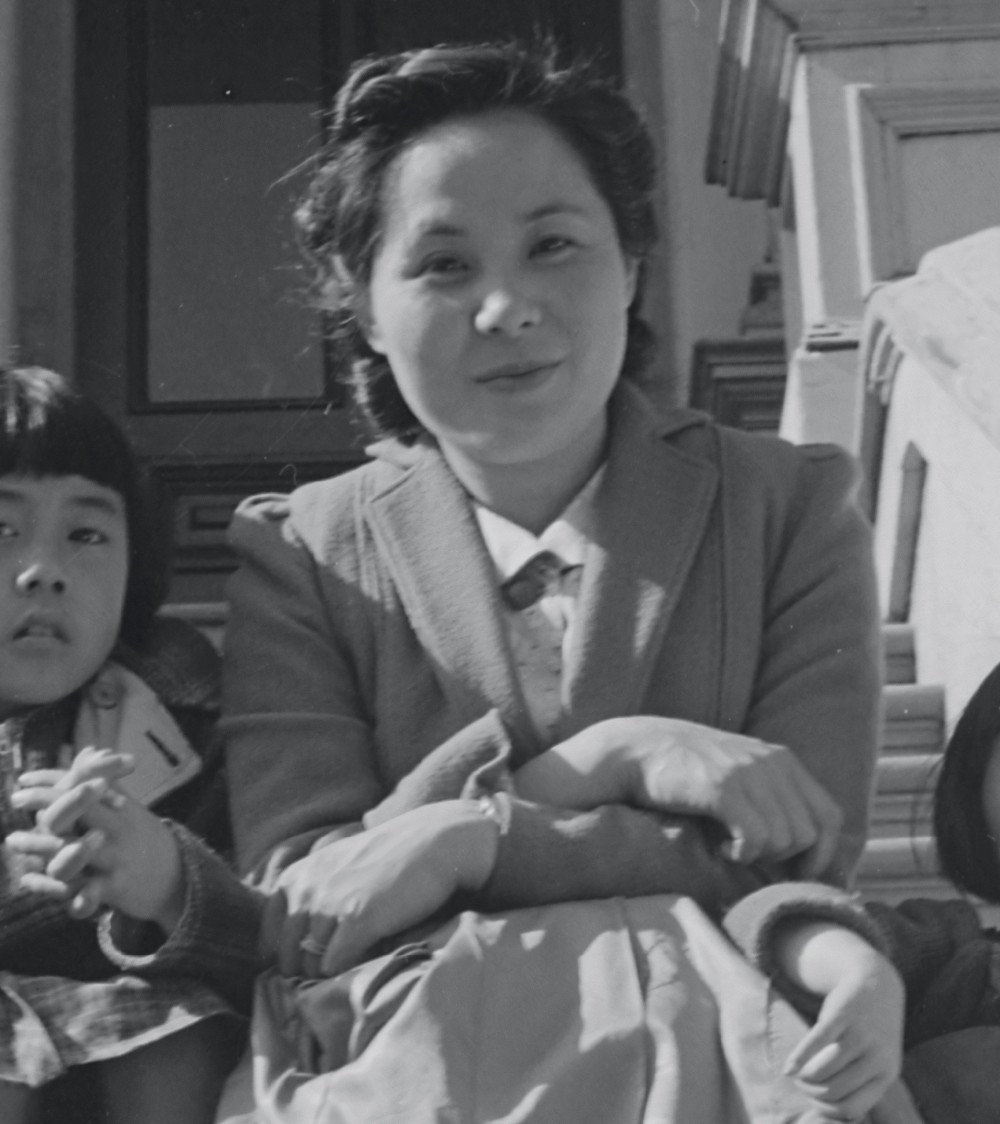
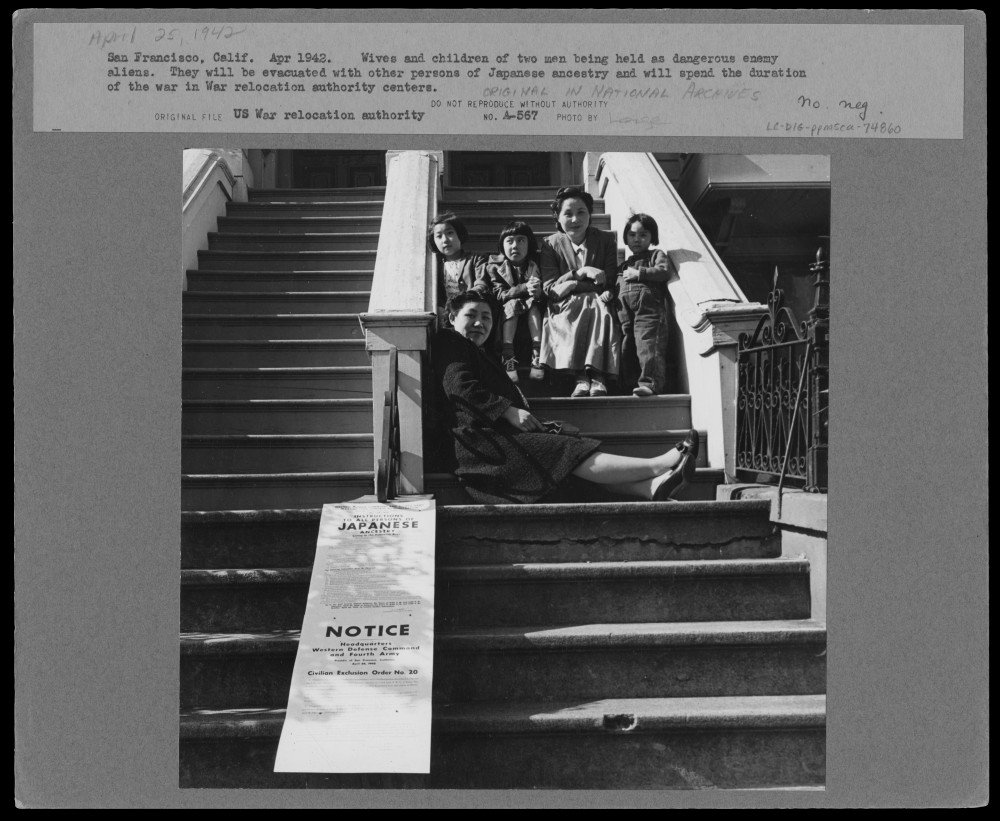
There are no mirrors in the photograph of Lange’s reproduced above; neither are her subjects’ eyes close enough to the camera to become reflective surfaces. What struck me in this work, the moment I first saw it, was the clear, penetrating gaze of the woman sitting midway up the stairs, the mother surrounded by her children. That look of hers pierced right through the camera’s lens, through the gaze Lange was directing at her—it was akin, somehow, to the smile of the merciful Kannon Bodhisattva. The structure of the image immediately reminded me of Velázquez’s “Las Meninas,” in which multiple gazes are layered on top of each other: first the king and queen, who are only visible to us through their reflection in the far mirror, then their child heirs, and then the painter himself, who is turned toward us, paintbrush in hand. And then there is you, the viewer, suddenly struck by the realization that you are the one whose portrait is being painted, that it is you who occupies the position of the king and the queen. Something similar happens in this photograph. It seems already to have incorporated the viewer, so that even 80 years later you become the intended recipient of the mother’s gaze.
First, we note that this photograph was taken in front of the San Francisco Japanese American Citizens League building. The people in the image are here because they are registering to be evacuated. They are preparing to cut their ties with the past, leave behind their land and their homes and their cars, arrange their finances. They have not been told anything about these so-called camps, where they will soon be taken and locked up. Their past evaporating before their eyes, the future as yet invisible, they are suspended mid-air in an uncertain present as they wait for the bus to arrive the following day. Imagine being in this suspended state, and then suddenly being approached by a group of white photographers—and not just one. This was the context for Lange’s photograph.
The thing that really stayed with me when I first came across this photograph was the mother’s smile. How did she manage to muster a smile like that amidst the chaos of packing bags, registering her family members, preparing to board the bus? Was it the photographer’s skill, or her own superhuman strength that drew it out? There is something cruel about the skill and cunning of a photographer homing in on their target. Quietly, carefully, the photographer approaches her, like a predator trying not to startle its prey.
We can see from the photograph that Lange was standing at the bottom of the stairs when she took it. The film is 6 × 6, meaning she was not using her usual large-format 4 × 5 Graflex camera. Instead, she was probably using a Rolleiflex. This kind of camera is sometimes referred to as a twin-lens reflex camera: the bottom lens shoots the image, while the top acts as a finder. The finder has a 45-degree mirror inside, and you peer down into it from above as you decide how to frame the picture. This is exactly what Lange must have been doing when she took this image. She pressed the shutter, that is to say, without ever making direct eye contact with the mother. Another feature of the Rolleiflex is that the position of the lens is lower than the eye—making it well suited to this kind of shot, angled up from below.
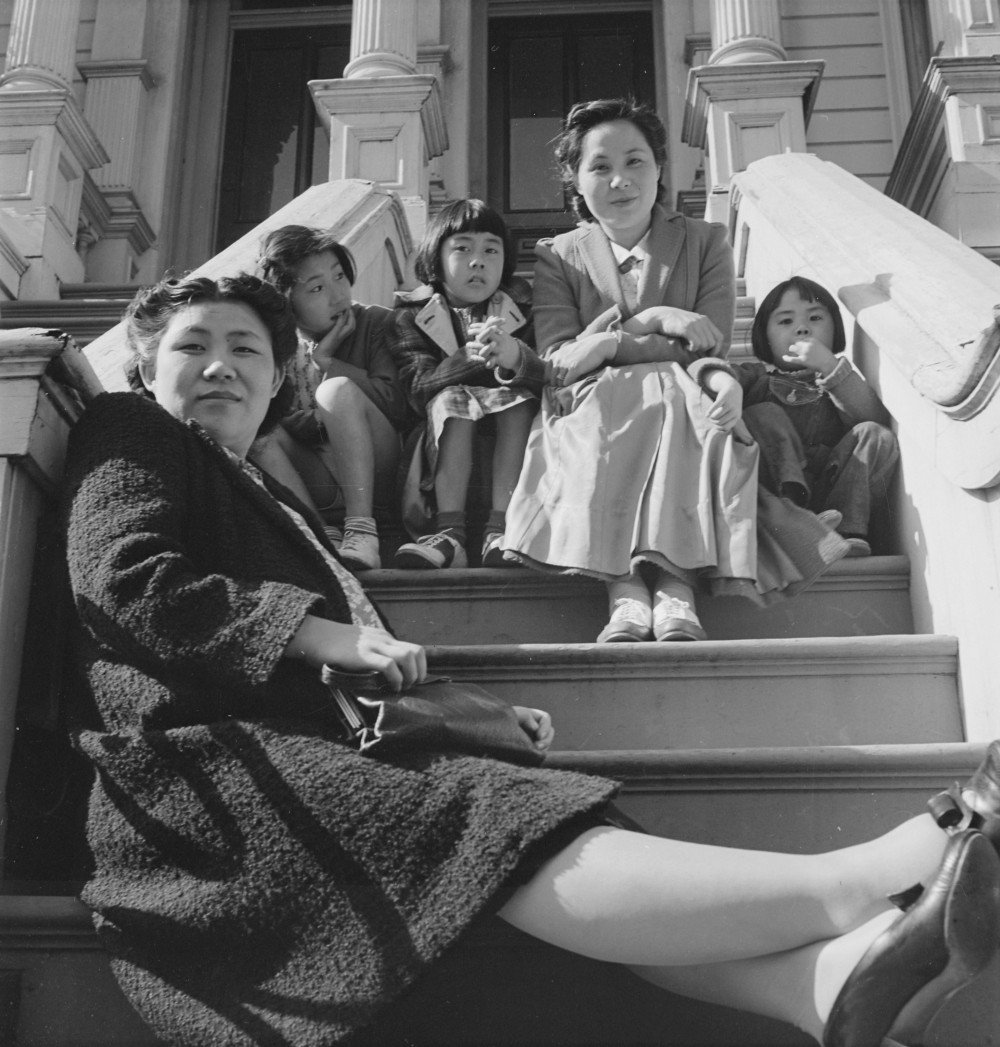
If you look carefully at the eyes of the five people in the image, you will see that the only ones looking directly at the camera are the mother and the child to her right; and that the friend, as well as the child sitting to the left of the mother, are looking at someone behind the camera. Someone else besides Lange must have been standing nearby. The friend is stretched out horizontally across the stairs, as though she were intentionally blocking the way. “So you want to take our picture? Well, go right ahead then,” her expression seems to say. The children eye the camera suspiciously, as if to say, “What does this lady want from us?” The mother’s expression alone is unimaginably tender. It is as if, through her smile, a silent moment of understanding passes between her and the photographer: “Rough times, eh? You and I both.”
Later, as I continued my endless search through various archives, I came across a series of Lange’s memos, as well as her correspondence with the Office for Emergency Management, a division of the War Relocation Authority, or WRA. Gasoline prices, trip expenses, phone bills, travel schedules—everything is recorded there. On one memo, I found a note that read: “April 25th we were doing the line outside the S.F.J.C.L. waiting to be processed. Mrs. F. Nakamoto was the pregnant woman sitting on the steps with her children. Address 1848 Buchanan. She wanted a picture of the children to send to her husband who had been sent to N. Dakota a couple of months ago.”
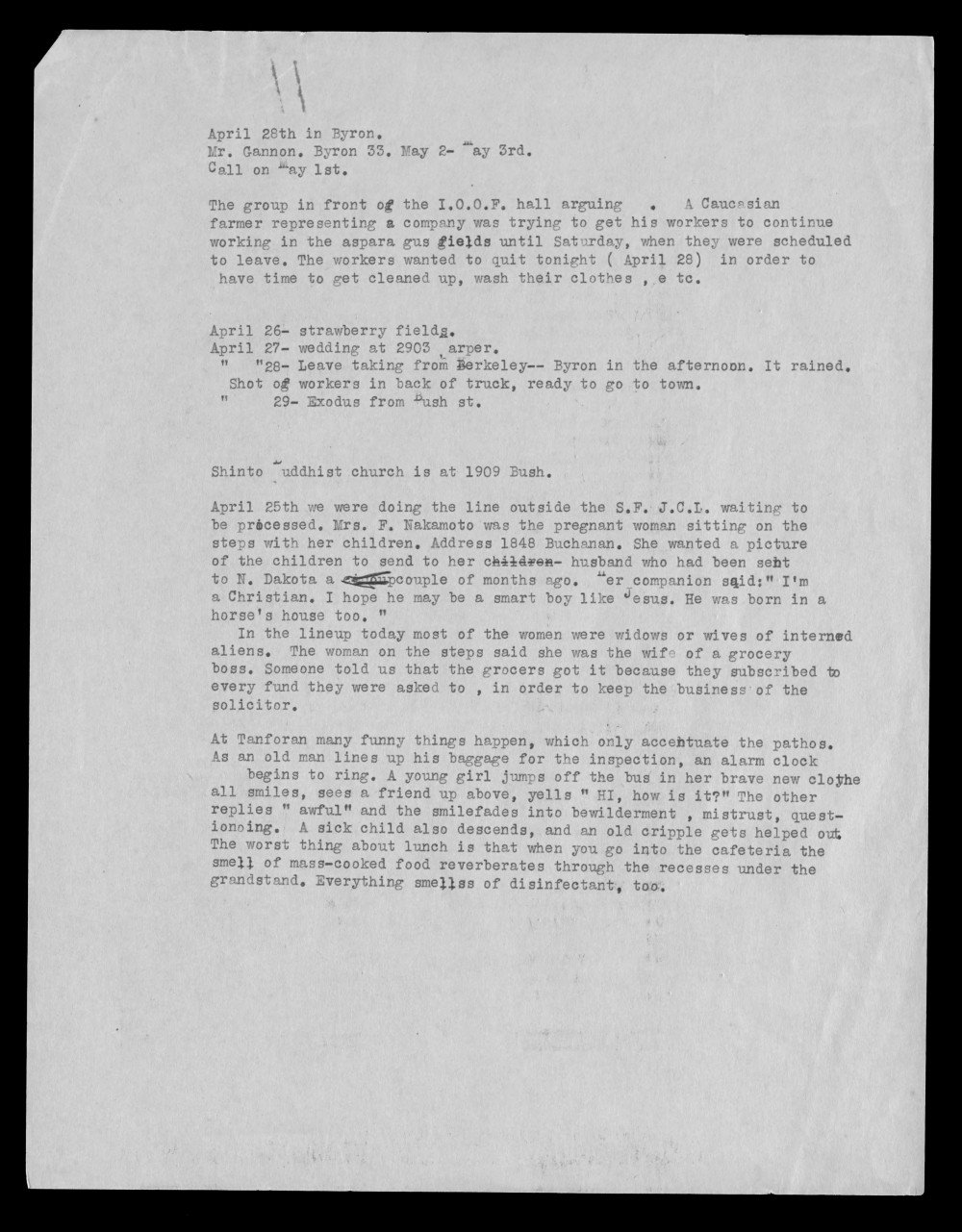
There it is—the memo tells us everything we need to know about the conversation that must have taken place between Lange and this woman. The mother in the photo, Mrs. Nakamoto, is not directing that tender expression at the photographer after all, but at her own husband, who is locked away in a faraway prison camp. “My love, we’re here, we’re all right. Are you?”
Here, then, is the uncanniness of photography; without knowing the context in which an image was taken, we, as latecomers to the scene, mistakenly assume that the subject’s gaze is directed at us. We are even more likely to make this assumption when a considerable amount of time has elapsed since the photograph was taken. Thus, a contemporary viewer might look at Mrs. Nakamoto’s smile in this photo and scoff, thinking, “How could someone who is about to be sent off to a concentration camp look so happy?” A photograph is born out of a brief moment of intimacy between a photographer and her subject—we, the viewers, are no more than transient passersby. It is a strange irony that these archival photographs can now be viewed, and judged, by absolutely anyone. All the more reason to make sure we do not forget how they came to be.
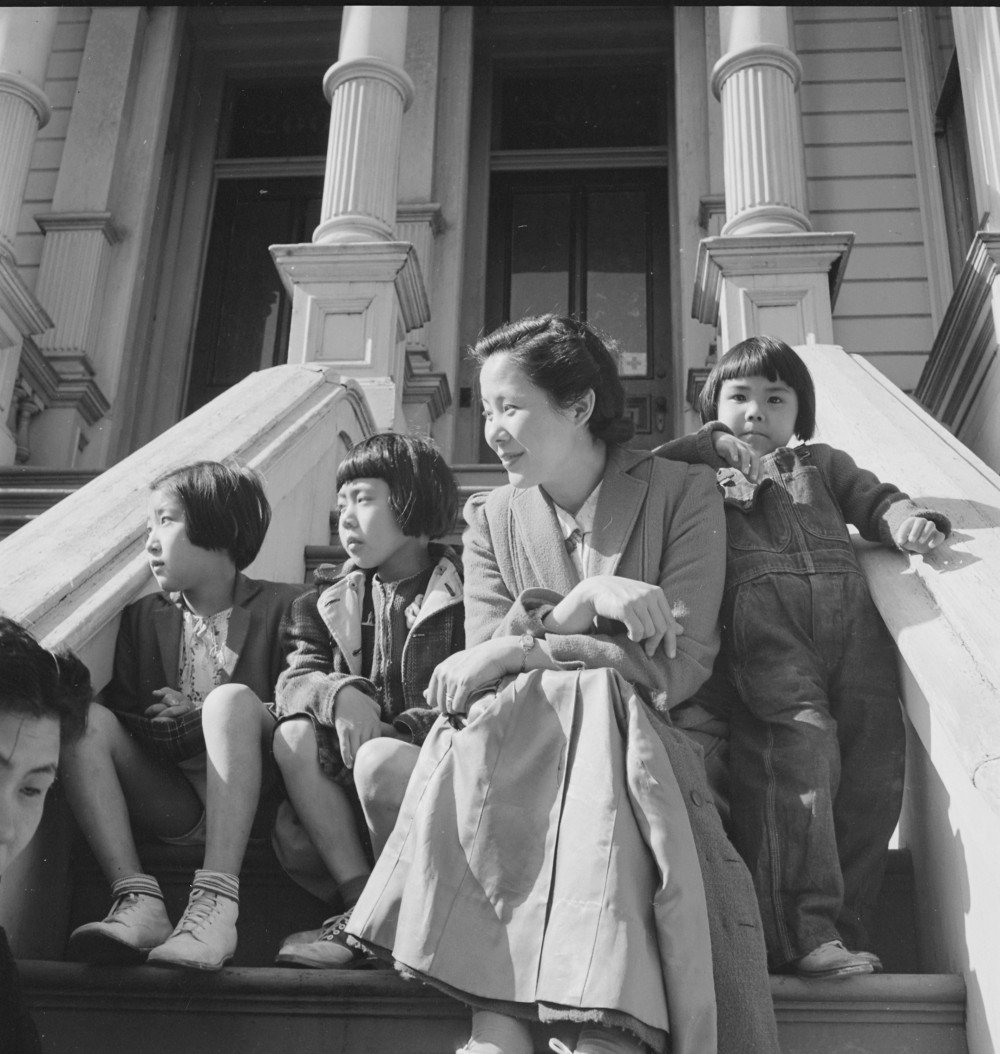
A photograph is a record of time, a container for a memory. The instant the photograph is taken, it already belongs to the past—an object against which we can set the present. It seems obvious, perhaps, but the present moment is always newer than the one in which the photograph was taken.
What if a photograph could depict the future, though? How could we ever turn our gaze away from such a work? This, essentially, is what is happening in this photograph; it contains a gaze directed at a specific person—the gaze of the mother, tendered toward her husband—who was not present when the picture was taken, but to whom, at some future time, the photograph was meant to be delivered. Standing before this picture, we realize that the gaze of the past is fixed upon us. But our exposure to this gaze is something we always experience, and can only ever experience, in the present. And so this photograph will never belong to the past; it will always be new.
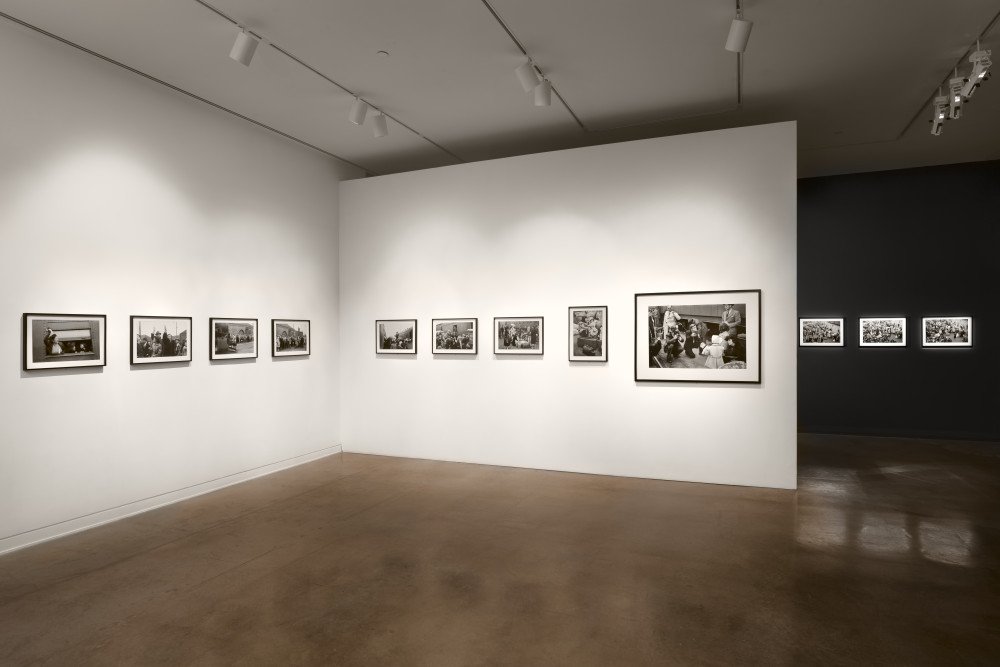
When we look at this photograph from our vantage point, 80 years later, we come, through Mrs. Nakamoto’s gaze, to occupy the position of her husband, just as we are placed in the position of the king and queen in Velázquez’s “Las Meninas.” It is hard to imagine another photograph like this being taken, and certainly the circumstances that produced it should never be repeated. All of this combines, in my view, to make this a true masterpiece in the history of photography. Its inclusion in the exhibit BeHere / 1942, in the form of a print made using a digital scan of the original negative, represents, as far as I know, the first time it has ever been shown.
Early in the morning of April 1, 1942, approximately one thousand Japanese Americans were loaded onto trains at Old Santa Fe station and shipped off to Manzanar. The fact that we have so many photographs of this day suggests that the government invited just about every local newspaper to come and report on the event.
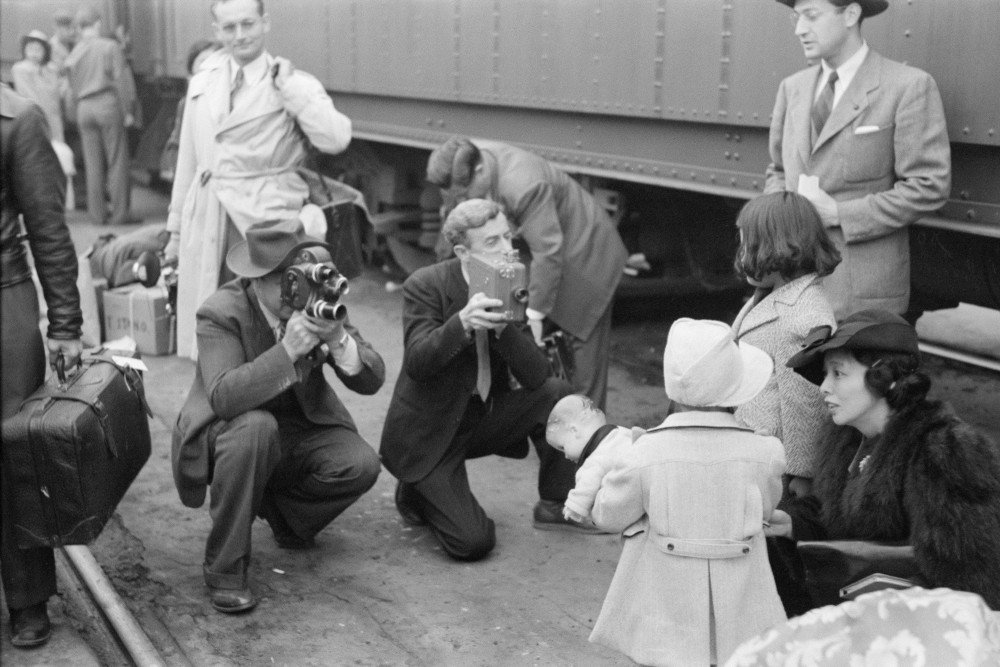
Among the photographers on the scene was Russell Lee. He was not a press photographer but one of several documentary photographers dispatched by the WRA. The photographs Lee took stand as a record of the drama that unfolded on April 1—a drama that included both the Japanese Americans gathered there and the photographers who captured them. However, it is not the figures who appear in the pictures, but those who have been intentionally excluded from them, who reflect the truth of the event. I am speaking here of the military police, the government officials, the Japanese Americans who cooperated with them, and the rest of the photographers.
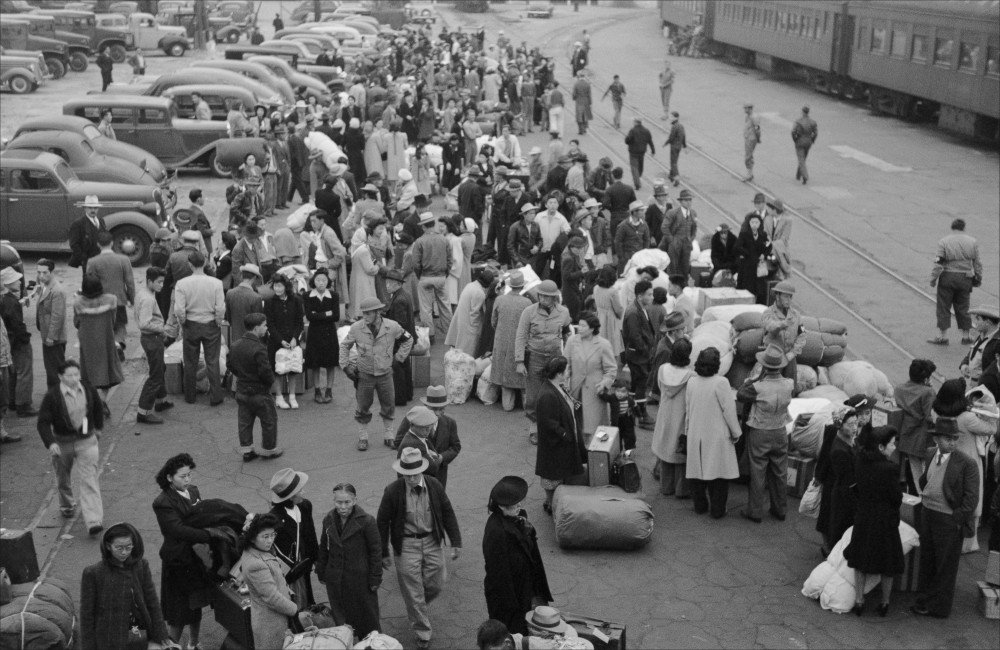
Some of the photographs Lee took on this day include people playing at least three distinct roles: the Japanese Americans being photographed; the government officials trying to convince the public that the evacuation of Japanese Americans has been a success; and finally, the photographers who are simply following orders. I suspect that Russell Lee had his own reservations about this configuration, in part because many of his photographs contain elements that contradicted his preferences as a photographer. We can sense from the images that he is torn.
Many of the photographs Lee took depict photographers other than himself. In intentionally capturing other photographers than himself, Lee is documenting the process by which press photographs are made. His photographs also serve as an important reminder of the simple fact that behind every photograph there is a photographer. Rarely, I think, has any archive allowed us to consider so deeply the relationship between photographer and subject.
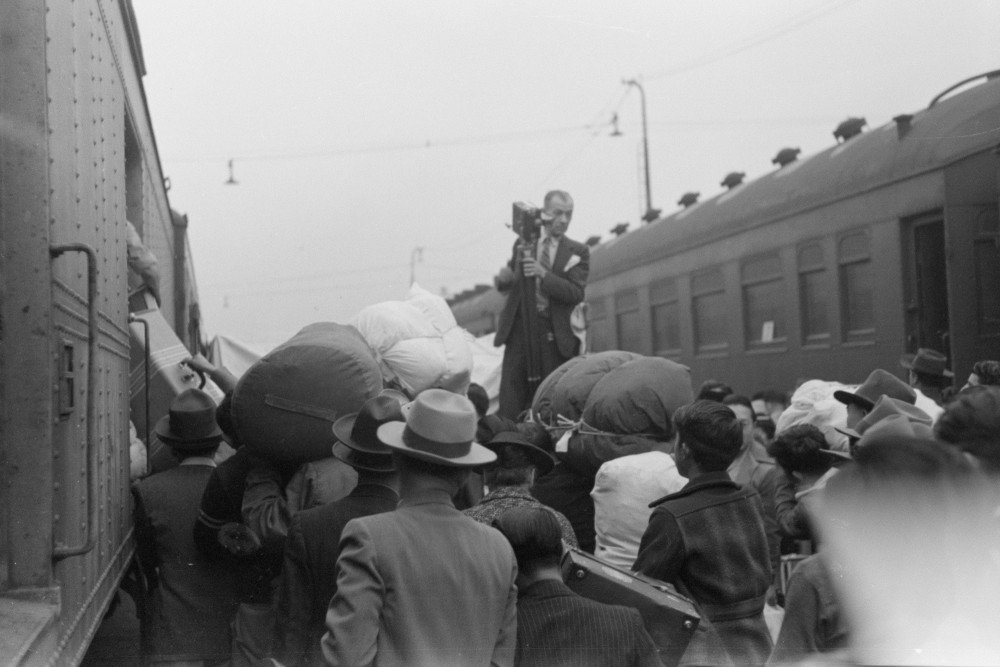
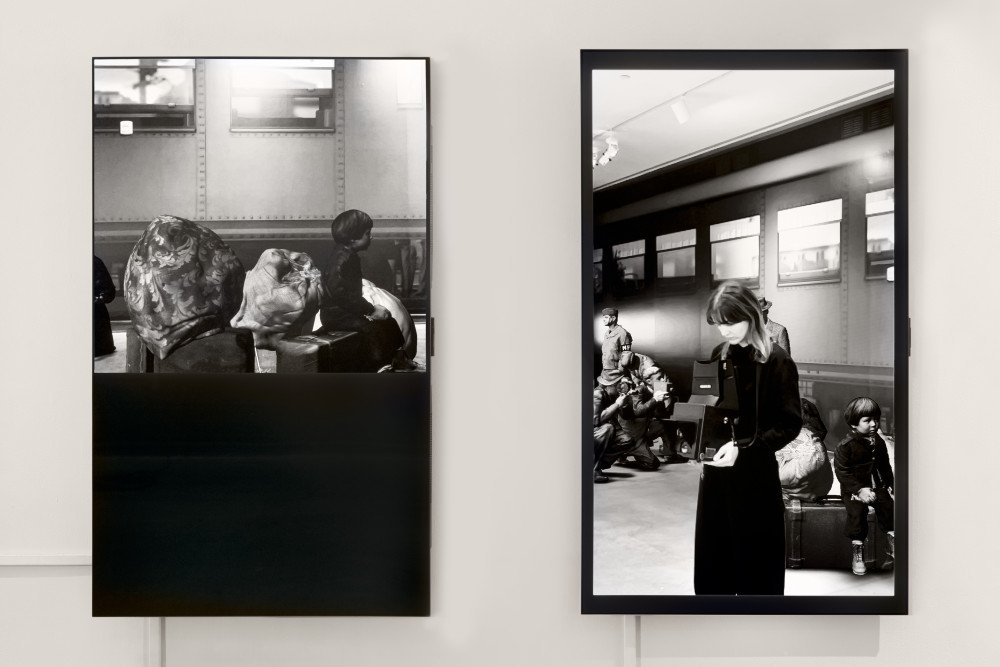
Part of my intention in this exhibit was to offer people a chance to consider, and to experience, what a photographer like Lee might have been thinking and feeling at the time. What was Russell Lee thinking as he stood there holding his camera, caught between his position as someone employed by the U.S. government and the Japanese American people who were being sent off to concentration camps before his eyes? In the exhibit, this became possible through a film created with 3D renderings.
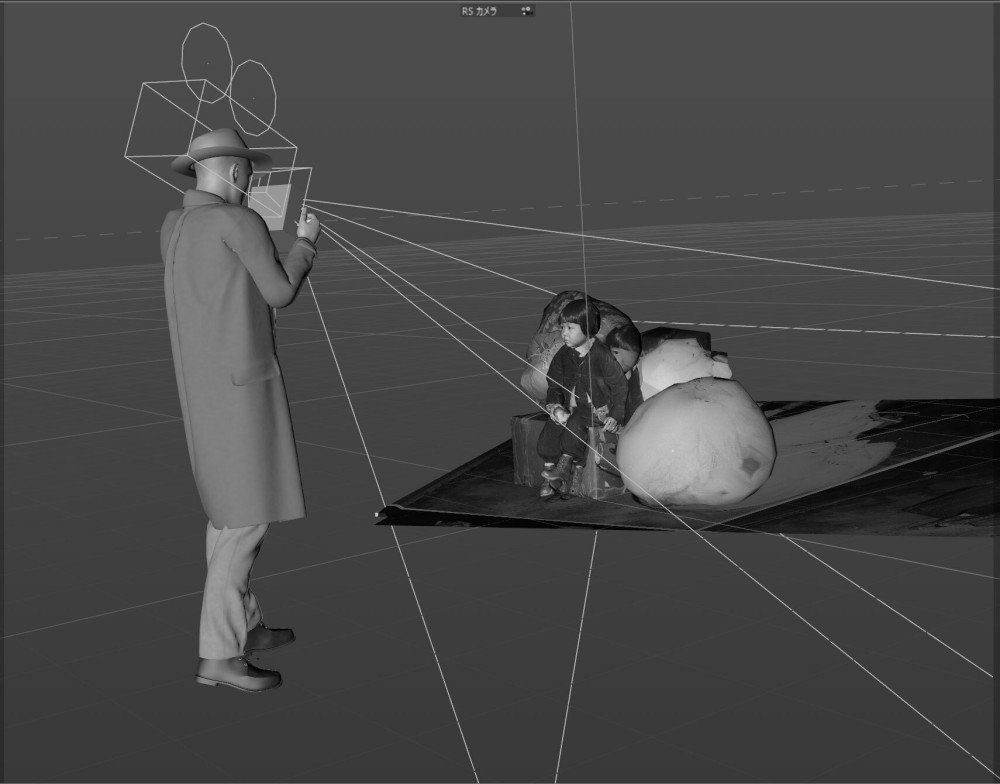
If you look closely enough at the photographs of this morning, you can more or less make out the order in which they were taken. You can imagine people moving from place to place as time passes, like characters in an epic poem. Now, thanks to 3D modeling, we, too, can lose ourselves in the distant time and space they inhabited, though we are separated from them by a distance of many decades. In the film, we see the flash of the press photographers’ cameras and feel the impact as those on the scene might have. By choosing to focus only on the photographers and their movements, while all the other figures remain still, we see how the photographers move like hunters, seeking out their subjects.
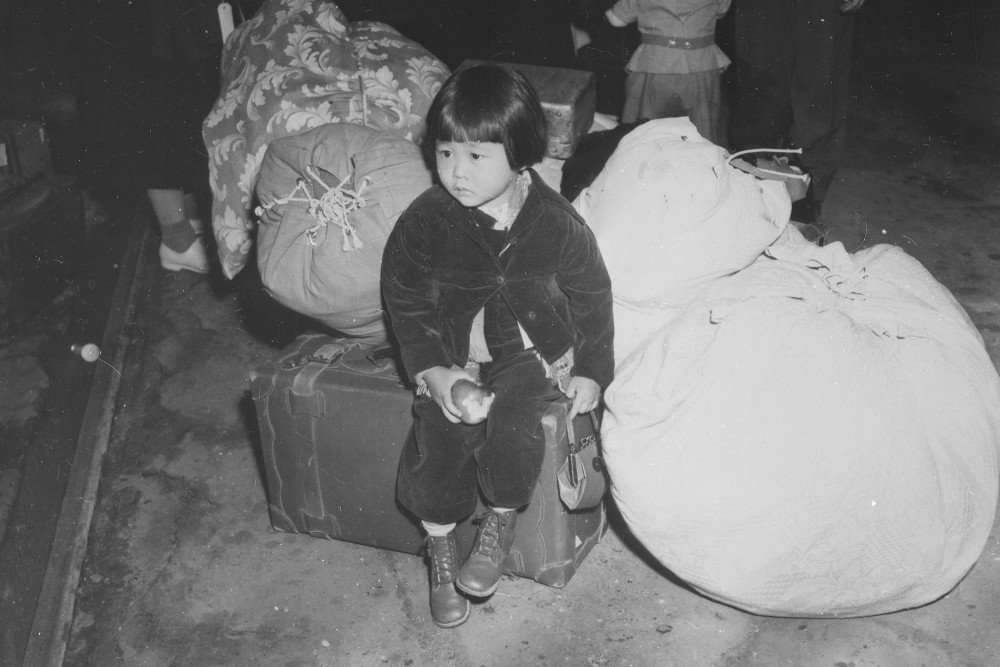
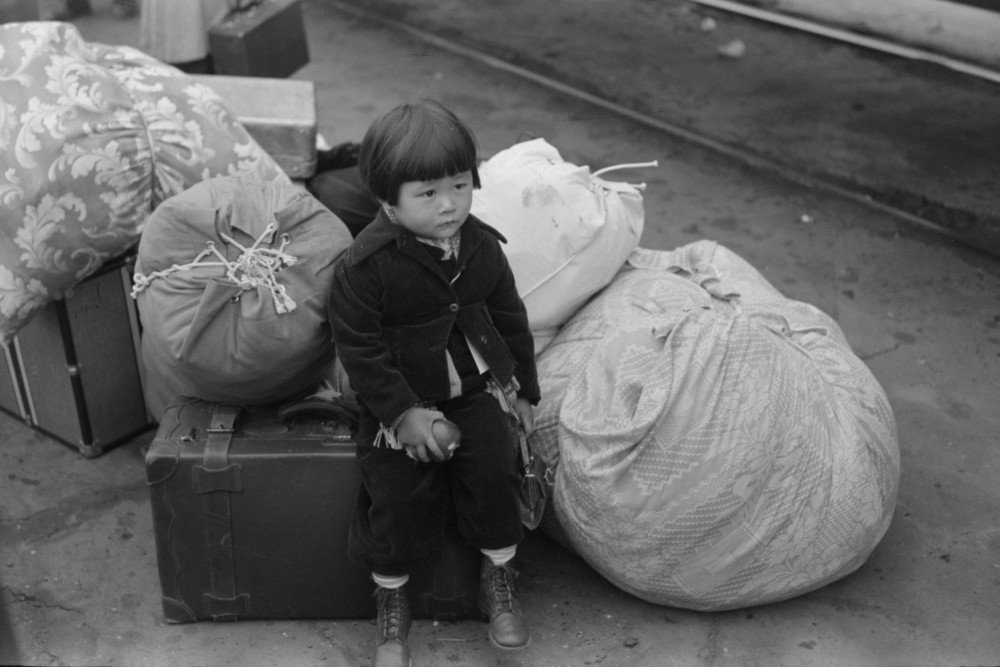
One such subject is a key figure that reappears across multiple images. “A little girl is sitting alone on top of a suitcase. She is not smiling. In her hand, she holds a half-eaten apple.” The photograph to which this caption corresponds, of a two-and-a-half-year-old girl named Yukiko Okinaga, has become a sort of emblem of the Japanese American incarceration—it appears, for instance, on the homepage of the National Archives website. In addition to being a striking image, it also allows the viewer to envision very clearly what the experience of being forcibly removed must have been like—it matches, in other words, our contemporary perspective on the trauma of the Japanese American incarceration.
But in addition to the famous photo by Clem Albers, which was taken with a flash, I found another, taken by Lee on his 35 mm camera without a flash. Was it a mere coincidence that the same girl appeared in two different photographs? Or was the girl intentionally chosen to be photographed—in other words, were the images staged? Comparing the two photographs, I can’t help feeling that the documentarian Lee captured the scene much more fully than the press photographer Albers did. In Lee’s representation, the little girl is not looking at the camera—she is looking off into the distance. Perhaps she is searching for her mother.
Time is a funny thing. It was Albers’s rather ordinary photograph, rather than Lee’s excellent one, that became famous. Presumably this is because, while Lee’s photograph was shut away in an archive, Albers’s was immediately published in newspapers and widely circulated. Lee’s picture, with its gentle gradations, has a freshness to it, almost as though it was taken yesterday. It conveys the atmosphere of the scene so vividly that the viewer comes to see the little girl not as an abstract icon of the incarceration, but as a living part of that unfolding moment—almost as if she had been frozen in time.
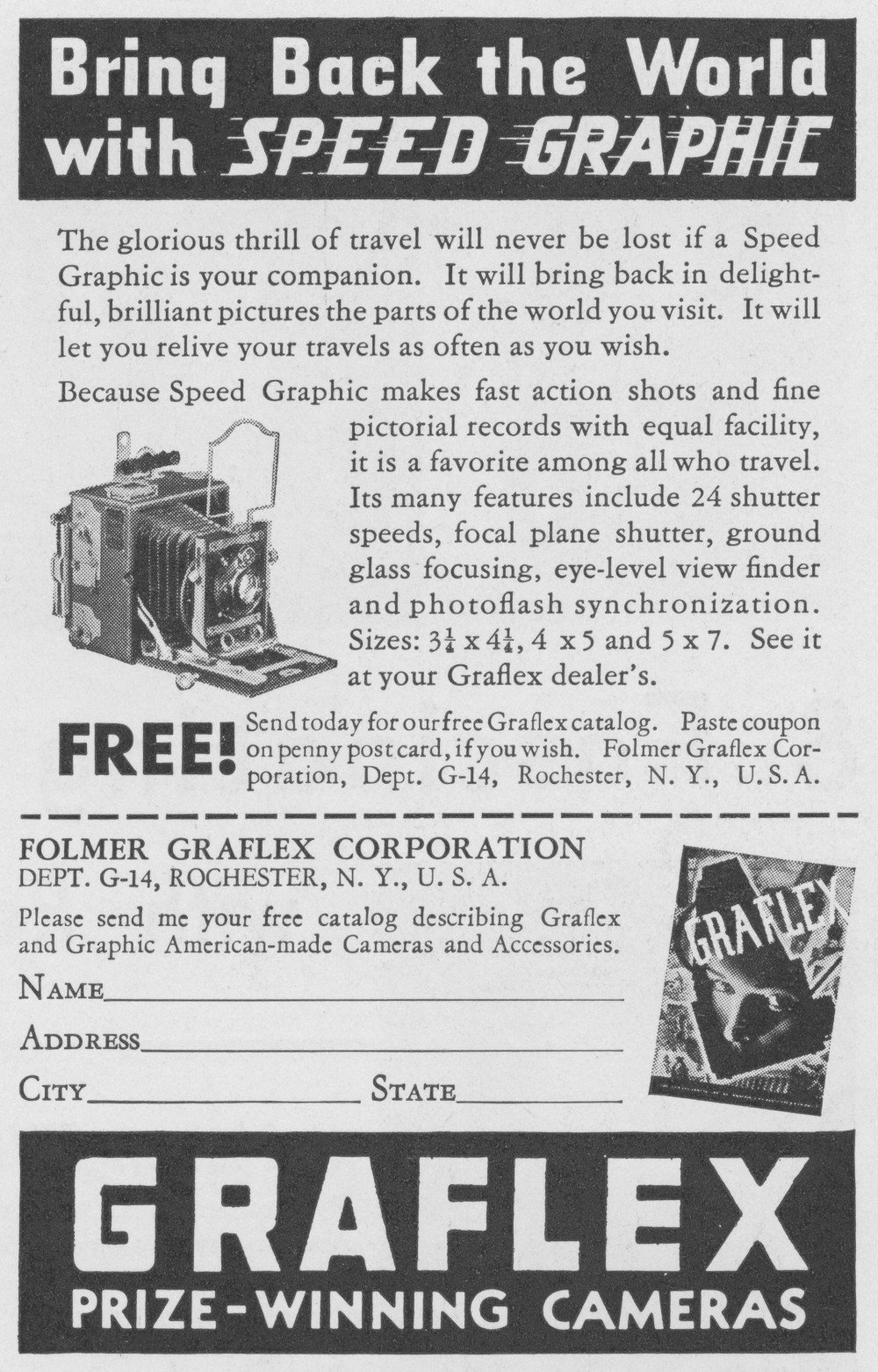
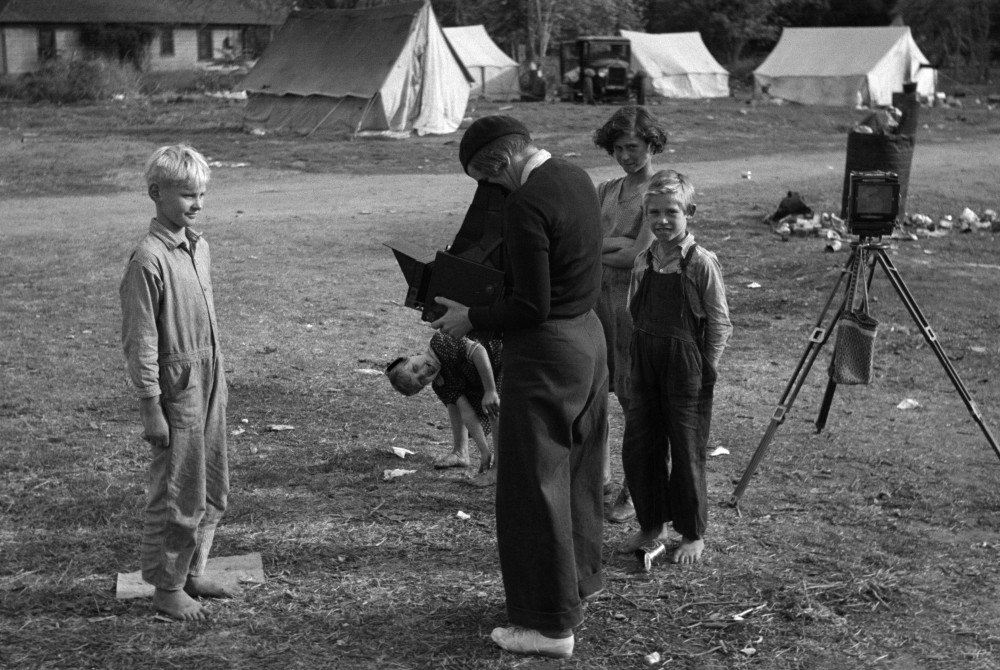
The idea that choices photographers make are shaped in important ways by the form and design of the equipment they use was summed up nicely by Vilém Flusser: “The photographer is programmed by his camera.” The way the lens and the viewfinder are positioned in relation to each other is just one example of this kind of programming. Together, the photographer and the camera exist in a kind of affordance, or complementary relationship, in which the photographer is controlled and programmed by the camera while she herself also tries to control the camera and make it yield to her vision. Perhaps there will come a day when the camera itself orders the photographer to do its bidding.
The Graflex camera that Lange most often used required the photographer to look down into the viewfinder from the hood on the top of the device. This meant the photographer’s eyes never met the subject’s head-on; instead, the photographer would stand directly opposite the subject while looking down into the camera. When first approached by a photographer holding this type of camera, the people being photographed would thus be a bit perplexed as to where they should direct their gaze—whether at the photographer or at the camera lens. Not knowing who it was that they were looking at no doubt added to the sense of confusion.
In contrast to Lange’s Graflex and Rolleiflex cameras, both 35 mm rangefinder and single-lens reflex (SLR) cameras work very differently: the viewfinder is located directly behind the lens, such that the photographer directing the lens at a subject resembles a hunter aiming a gun at an animal. In addition, due to the relatively small size of the cameras, they are also less bulky, meaning that—at least in close proximity—the subject of the photograph can actually see the face of the photographer. Before the subject even realizes what has happened, the photograph has already been snapped. Lange disliked this aspect of the 35 mm camera, since it seriously compromised the process of obtaining consent from the subject, something she could not abide. When using a larger camera, the photographer must obtain the consent of the subject in order to take the shot. She believed that the essence of photography lay in that consent.
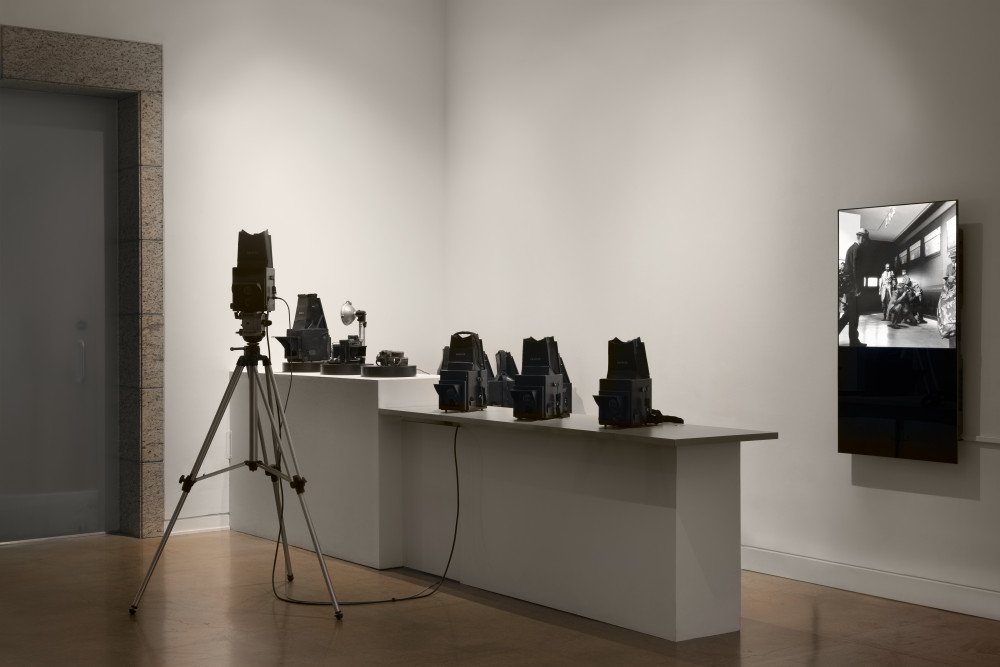
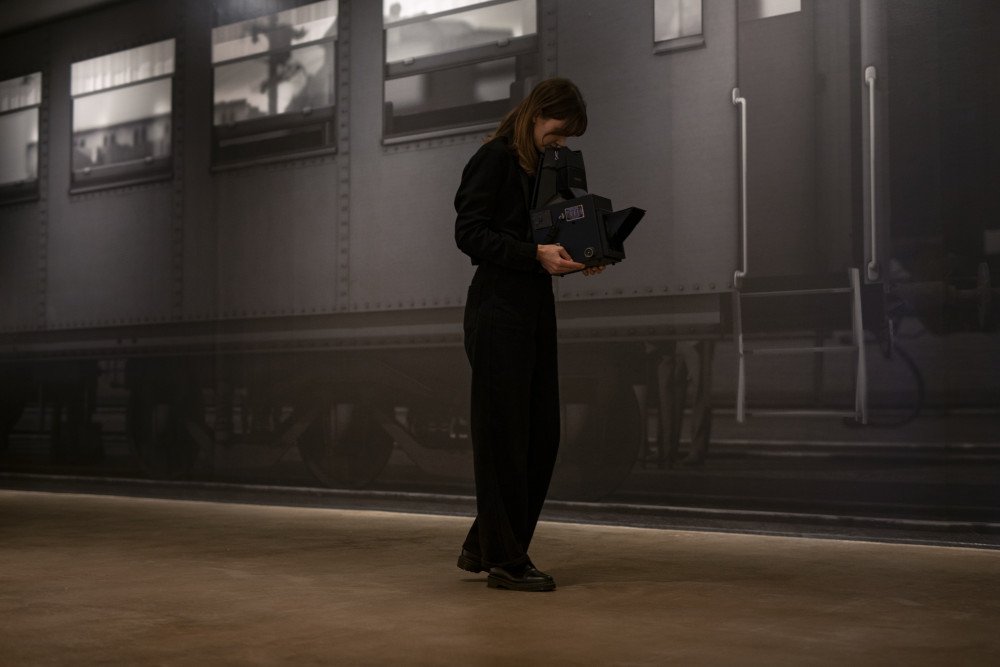
Creating 3D renderings makes it possible to offer visitors a chance to use a camera themselves. In the exhibit, I opted to give visitors not the small-scale Contax camera manufactured by Zeiss Ikon that Russell Lee used, but rather a Graflex Super-RB camera of the sort beloved by Dorothea Lange—who, it should be noted, was not part of the scene at the Old Santa Fe station.
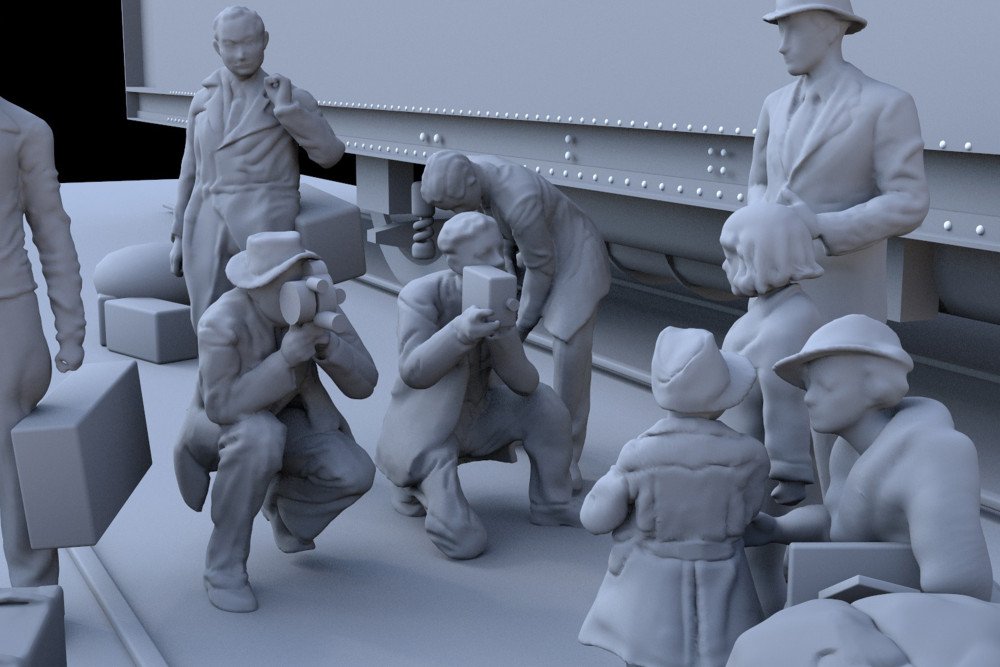
The cameras visitors are given are not originals; they are replicas with AR technology embedded inside them. With these cameras in their hands, museum visitors are invited to put themselves in Lange’s shoes, viewing the scene from her perspective, through the viewfinder, so that they can enter into the scene where the events took place, into that epic poem of the Old Santa Fe station.
In the wake of Pearl Harbor, and when the news came that President Franklin D. Roosevelt had signed Executive Order 9066, Japanese Americans up and down the West Coast of the United States began emptying their homes of possessions that spoke to their Japanese roots. Photographs of family back in Japan, kimono, picture postcards, antique dishes…anything that might lead an FBI agent to question a family’s allegiances had to go. In backyards across California, ties to the past were sacrificed to hastily kindled fires in a doomed effort to preserve the present and the future it implied.
At some point, during the years I spent conceiving and realizing the exhibition and public arts installation BeHere / 1942, which drew on cutting-edge augmented reality technology to make visible, in the present, a group of Japanese Americans waiting, in 1942, to board a bus that would carry them to a concentration camp, I began envisioning an old picture scroll, brought over in a suitcase decades earlier, crackling in the flames of one of those backyard bonfires. Surely some such artworks, prized for generations, must have been among the treasures Japanese Americans felt compelled to destroy.


An augmented reality (AR) rendering of the bus used to transport Japanese Americans from Los Angeles to Manzanar.
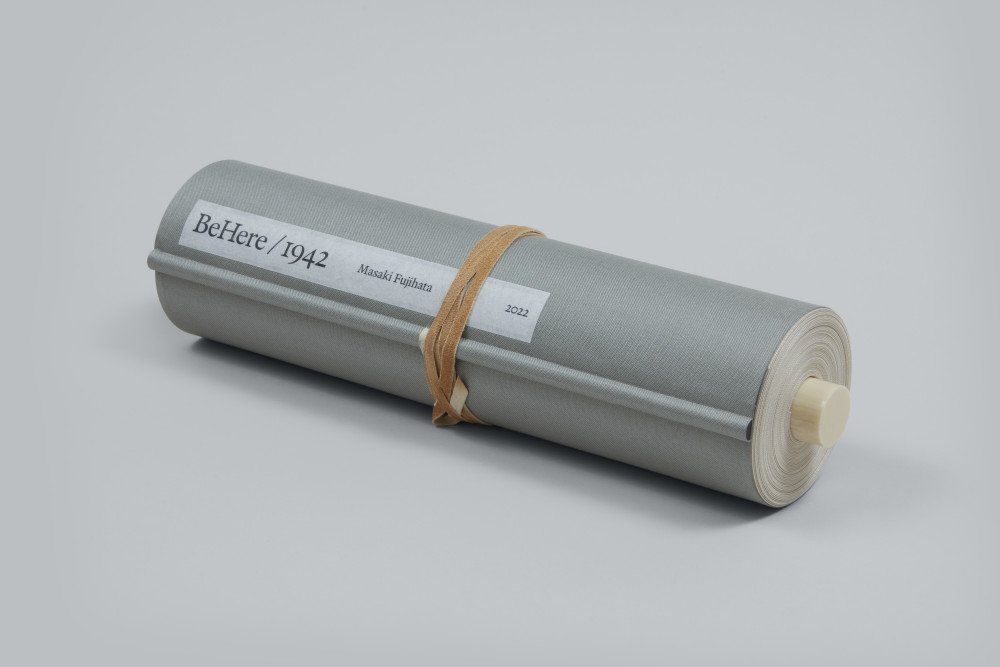
I decided to create this scroll, borrowing a material form deeply embedded in Japanese culture, to close the loop symbolically between the absent physicality of all that was lost in 1942 and my own attempt, eight decades later, to call that history virtually into the present. Here, in this object simultaneously new and old, BeHere / 1942 is reimagined in a shape whose weight its subjects might have felt.
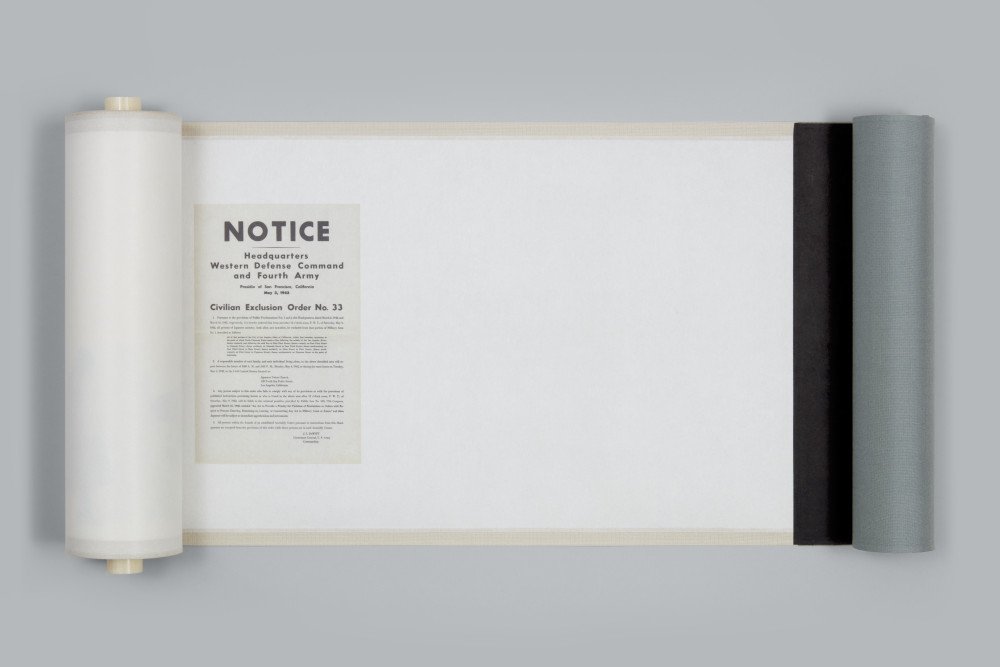
The scroll opens with Civilian Exclusion Order No. 33, which covered Nishi Hongwanji Temple—the historically important site of the virtual installation—and most of Little Tokyo. Then a few Japanese Americans appear, and more, walking along together, talking, old friends exchanging bows, reaffirming their ties to one another. Eventually, they are told to get into line. A government official checks the tags they have been instructed to wear, which record not names but family numbers; and then, at last, it is time to board the bus that has just pulled up and is waiting to take them away. The scroll ends with a blank space that limns the terrible uncertainty of the future. Evidently no one was told where the bus was headed until after it began to move.
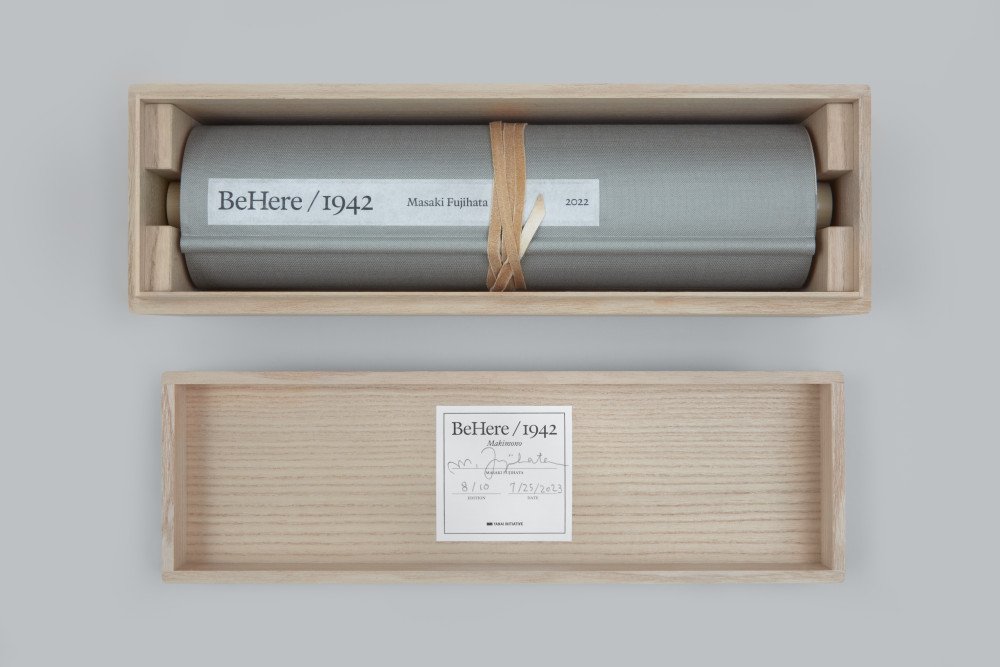
This picture scroll is one of a limited edition of ten created as a final conceptual addition to Masaki Fujihata’s exhibition and public art installation BeHere / 1942: A New Lens on the Japanese American Incarceration, which was first shown at the Japanese American National Museum from May 7, 2022, to January 8, 2023. It was conceived and produced as a collaboration between Fujihata and the Yanai Initiative at UCLA and Waseda University.
Production of the scroll began in June 2022. Masaki Fujihata created the image using data from the augmented reality installation that forms the core of BeHere / 1942; it was printed in Kyoto with a swissQprint high-resolution inkjet printer on double-layered Japanese mulberry paper crafted at Awagami Factory in Tokushima Prefecture. Itsuo Fushimi mounted the prints at his studio in Gifu Prefecture. The pure silk for the cover and borders was woven at the Namakura Kinran Factory in Hiroshima. The roller is simulated ivory; the cord is smoked deer hide from Nara prefecture. The box was assembled by Shimpei Kawachi using American and Japanese Paulownia wood. Kishida Norikazu oversaw this entire process, with the aim of producing a scroll capable of lasting a thousand years.